
.png)

Composite Decking Cost 2026: Hollow Composite vs Millboard

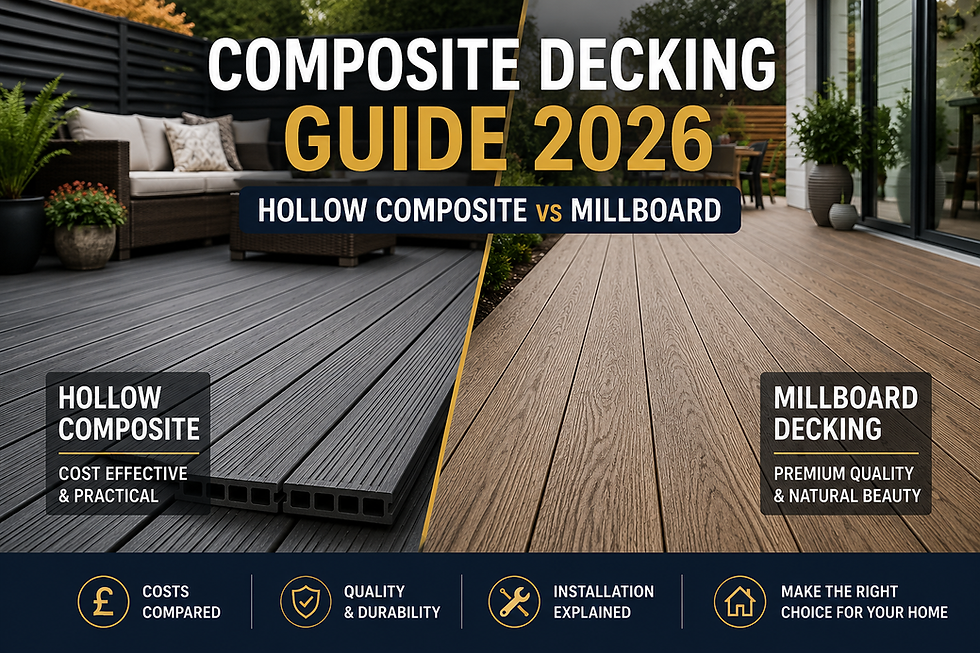
If you're considering a new deck, one of the first things you'll notice is the enormous difference in price between different types of composite decking.
At one end of the market are lower-cost hollow composite decking boards. At the other are premium products such as Millboard.
Both can create an attractive, low-maintenance outdoor space, but they aren't directly comparable products.
So, how much does composite decking cost in 2026, what's the difference between hollow composite and Millboard, and which should you choose?
At Sale Fencing & Surfacing, these are questions we're increasingly being asked by homeowners across Sale, Altrincham, Trafford and South Manchester.
This guide explains the options.
How Much Does Composite Decking Cost in 2026?
The biggest mistake when comparing decking prices is looking only at the cost of the boards.
A complete decking installation can include:
Decking boards
Subframe
Posts or supports
Clips and fixings
Fascia boards
Steps
Ground preparation
Drainage considerations
Removal of an existing deck
Labour and installation
Current UK pricing varies considerably according to the product. Hollow composite boards can start around £30–£50 per m² supply-only, while premium products can cost considerably more. Fully installed composite decking commonly falls somewhere around £80–£200 per m², although complex installations can exceed this.
These figures should only be treated as general guidance.
A raised deck with several steps, detailed edging and substantial subframe construction can cost considerably more than a simple rectangular deck built at low level.
Why Are Some Composite Decking Boards So Cheap?
Not all composite decking is constructed in the same way.
One of the most obvious differences is whether the board is hollow or solid.
Hollow composite decking contains internal cavities rather than being solid throughout.
This reduces the amount of material required to manufacture each board and generally makes the boards lighter and cheaper.
That can make hollow composite an attractive choice when budget is one of the main considerations.
Current indicative prices for hollow-core composite are around £35–£45 per m² for the boards themselves.
Is Hollow Composite Decking Any Good?
It can be.
We wouldn't describe hollow composite decking simply as "bad" and premium decking as "good".
The important question is whether the product is appropriate for the particular installation.
A decent hollow composite system installed correctly can provide an attractive and relatively affordable alternative to timber.
However, customers should understand that cheaper hollow boards won't necessarily provide the same feel, construction or long-term performance as a premium decking system.
Installation is also extremely important.
The manufacturer's specified joist spacing, ventilation, expansion gaps and fixing system should always be followed. Some hollow-board manufacturers also recommend solid boards instead in areas with restricted airflow or particular high-use applications.
What Is Millboard Decking?
Millboard sits at a very different end of the market.
Although it's commonly grouped under "composite decking", Millboard doesn't use the conventional wood-plastic composite construction found in many WPC decking boards.
It uses a resin-mineral core with an elastomer surface, designed to recreate the appearance of real timber while providing high resistance to moisture and mould.
The surface is moulded from real timber to create realistic grain and texture.
That premium construction is one reason Millboard is considerably more expensive than entry-level composite decking.
How Much Does Millboard Cost?
This is where homeowners often get a surprise.
Millboard's April 2026 UK retail price list shows its 176mm Enhanced Grain boards at approximately £154–£164 per m², depending on colour, with some narrower Enhanced Grain products approaching £200 per m².
That's for the decking product — not a complete installed deck.
Compare that with roughly £35–£45 per m² for entry-level hollow composite and it's easy to understand why two quotations for apparently similar-sized composite decks can be thousands of pounds apart.
Hollow Composite vs Millboard
Here's the simplest way of looking at the two.
Hollow Composite | Millboard | |
Initial cost | Lower | Significantly higher |
Construction | Hollow WPC typically | Resin-mineral composite |
Weight | Generally lighter | Substantial premium board |
Appearance | Varies by manufacturer | Highly realistic timber effect |
Product choice | Huge range | Premium specialist range |
Maintenance | Low | Low |
Best suited to | Budget-conscious projects | Premium installations |
Board cost | From roughly £35–£45/m² | Roughly £155–£200/m² |
The precise specification varies between manufacturers, so customers shouldn't assume every hollow composite board performs identically.
What About Solid Composite Decking?
There is also a large middle ground.
You don't necessarily have to choose between an inexpensive hollow board and Millboard.
Traditional solid-core composite decking is available at several quality and price levels.
Millboard's current comparison puts uncapped solid-core composite around £55–£75 per m² and capped solid-core products at approximately £80–£180 per m².
This means there are potentially three broad choices:
Budget: Hollow composite
Mid-range: Higher-quality capped or solid composite
Premium: Millboard or comparable premium systems
Composite Decking Hollow Composite Decking Millboard Composite Decking
For many homeowners, comparing all three makes more sense than simply asking for "composite decking".
The Subframe Is Just as Important
One of the least glamorous parts of a deck is also one of the most important.
The structure underneath it.
You can purchase excellent decking boards and still end up with a poor deck if they're installed onto an inadequate subframe.
The structure needs to provide suitable:
Joist spacing
Support
Drainage
Ventilation
Ground clearance
Fixing points
Expansion provision
Joist spacing in particular must follow the decking manufacturer's specification. Requirements differ between products; assuming that a frame suitable for timber will automatically be suitable for composite can cause problems.
Timber or Composite Subframe?
This is another decision that affects the quotation.
A properly specified treated timber subframe can reduce the initial installation cost.
Alternatively, composite or specialist structural systems can be considered where customers want to minimise timber within the construction.
The appropriate solution depends on the height of the deck, ground conditions, drainage, expected lifespan and decking system being installed.
This is why comparing quotations solely on a £/m² decking-board price can be misleading.
What Makes Decking Installation More Expensive?
Several things can increase the final cost.
Raised Decking
The higher the deck, the more structural work is generally required.
Steps
Steps require additional framing, boards, cuts and finishing.
Fascia Boards
Finishing exposed edges neatly adds both material and labour.
Complicated Shapes
Curves, angles, posts and unusual boundaries increase cutting and installation time.
Poor Ground Conditions
Ground preparation and suitable support may be required before the deck structure can be constructed.
Removing Existing Decking
Old timber decking and its substructure may need dismantling and disposal.
Premium Subframes
Using specialist structural systems instead of conventional treated timber increases the material cost.
Why Can Two Decking Quotes Be Thousands Apart?
This is probably the most important point in this guide.
Imagine two contractors quoting for the same garden.
One quotation uses:
Hollow composite + straightforward treated timber frame
The other uses:
Millboard + premium structural system + detailed fascia and steps
Both quotations might simply be described as:
"New composite decking."
But they're completely different specifications.
Before comparing prices, ask exactly which decking board, subframe, fixings and finishing details are included.
Is Millboard Worth the Extra Money?
For the right project, it certainly can be.
We'd particularly consider a premium product where:
The deck is a major feature of the garden
Appearance is extremely important
The homeowner wants a convincing timber appearance
The property warrants a premium finish
Long-term performance is prioritised over lowest initial cost
The customer expects to remain at the property for many years
But not everybody needs Millboard.
If the priority is creating an attractive, practical deck within a tighter budget, a correctly specified composite system may make much more financial sense.
Should I Choose Composite Decking or a Patio?
This is another question worth considering before making the final decision.
A deck can be particularly useful where:
Levels need to be raised
The garden slopes
A timber-style appearance is wanted
Building a conventional paved area would require extensive level changes
The homeowner prefers the feel of decking
Porcelain or natural-stone paving may be preferable where customers want a solid paved surface with a different appearance and construction.
Sometimes the best garden design actually combines decking and paving.
Which Composite Decking Should I Choose?
Our advice is not to start with the brand.
Start with three questions:
What do I want it to look like?
How long do I expect it to perform?
What is my realistic budget?
Then compare products that meet those requirements.
For some homeowners, hollow composite will provide exactly what they need.
Others may decide that spending more on solid or capped composite represents the best compromise.
And for customers wanting a genuinely premium deck, Millboard becomes a very strong option.
Composite Decking Installation in Sale & South Manchester
Sale Fencing & Surfacing provides outdoor landscaping and installation services across Sale, Altrincham, Hale, Bowdon, Timperley, Urmston, Didsbury and surrounding areas of South Manchester and Cheshire.
If you're considering composite decking, we can discuss the different approaches available rather than simply quoting one product regardless of budget.
Depending on the project, this can include comparing cost-effective composite decking, higher-specification composite systems and premium options such as Millboard.
The objective is to find the right balance between appearance, construction, longevity and budget.
Planning a new deck?
Contact Sale Fencing & Surfacing to discuss your project and arrange a quotation.
Email: info@salefencing.co.uk
Tel 0161 980 8333
Online quote form: https://www.salefencing.co.uk/enquiry-form


Comments