
.png)

Bespoke Timber Gates vs Shop-Bought Gates Guide for UK Homeowners


A timber gate has a hard job. It needs to look right, swing cleanly, cope with rain and wind, and stay stable through years of UK weather. The difference between a gate that lasts well and one that starts to drop, twist or split often comes down to more than the species of timber.
Construction, correct sizing, posts, hinges, ironmongery and installation all matter. Sometimes they matter as much as the timber itself.
This guide explains the practical differences between lower-cost shop bought gates, made-to-measure softwood gates, traditional mortice-and-tenon framed gates, and hardwood gates as a premium option. It’s wr
itten for homeowners comparing wooden garden gates or timber driveway gates in Sale, Altrincham, Trafford and nearby areas.
What is a shop-bought timber gate?
A shop-bought timber gate is usually a mass-produced gate sold in standard sizes through DIY stores, builders’ merchants or online retailers. These gates can be a sensible option for simple openings, especially where budget is the main concern.
They’re usually made to common widths and heights, which keeps costs down. Many are softwood gates, often supplied untreated, dip-treated or pressure-treated depending on the product.
Shop-bought gates can work well when:
The opening is a standard size.
The ground is fairly level.
Existing posts are strong and correctly positioned.
The gate is for light garden use.
The homeowner is comfortable fitting and adjusting it.
The compromises tend to show when the opening isn’t square, the posts are weak, or the gate is expected to handle regular use. A cheaper gate may also have lighter framing, thinner boards or simpler joints. That doesn’t make it bad, but it does mean it has limits.
Common issues with lower-cost timber gates include:
Gaps that are uneven because the gate doesn’t quite fit the opening.
Dropping over time if the frame is light or poorly braced.
Movement in the boards as timber expands and contracts.
Hinges pulling away if fixed to unsuitable posts.
Shorter service life if treatment and maintenance are neglected.
For a back garden side gate, a shop-bought option may do the job. For a prominent front entrance or regular driveway use, it’s worth looking at how the gate is built and fitted.
What is a bespoke timber gate?
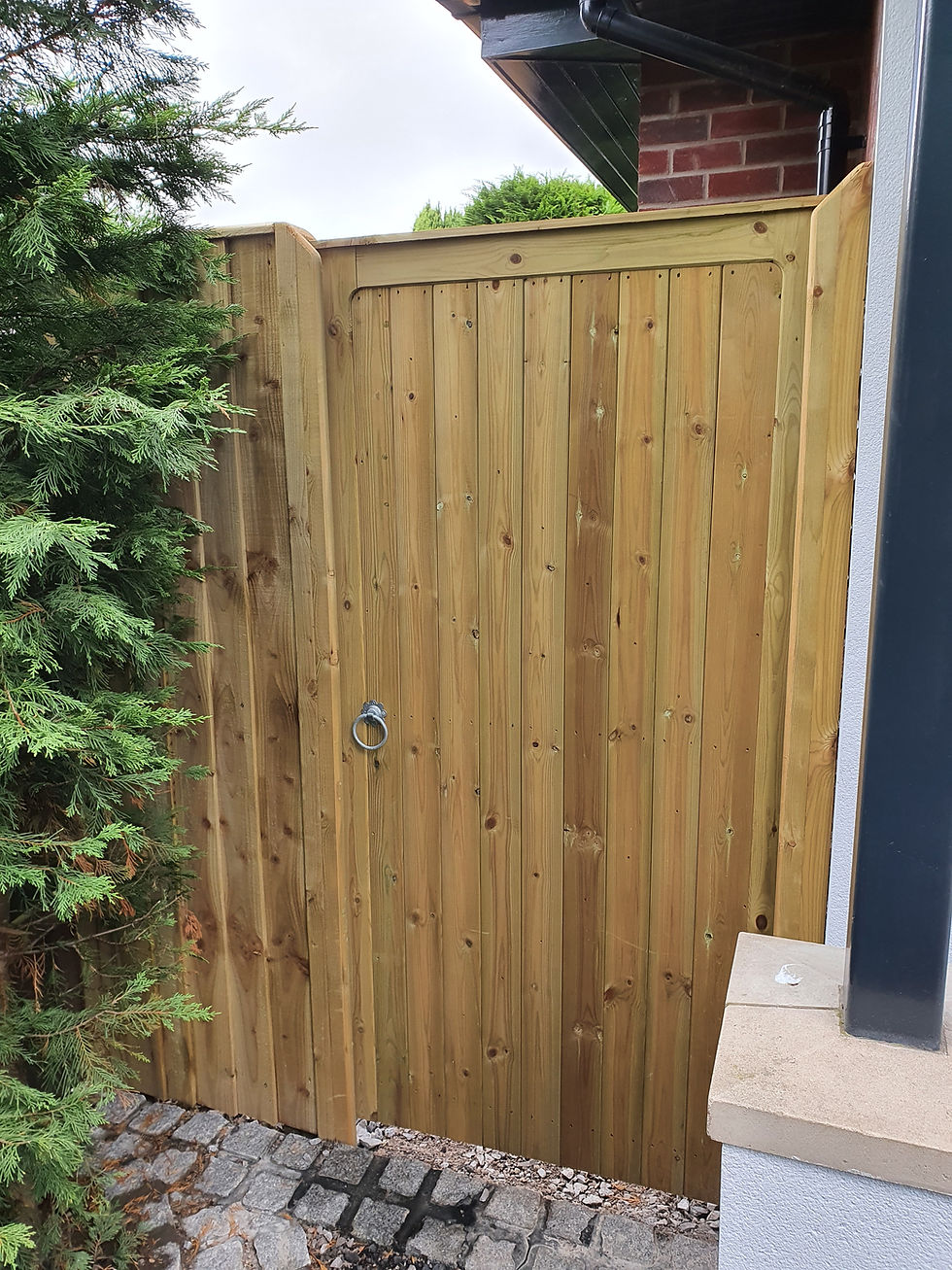
A bespoke timber gate is made to suit the opening rather than forcing the opening to suit the gate. That means the width, height, framing, board layout and hanging arrangement can be planned around the property.
Sale Fencing & Surfacing specialises in bespoke timber gates made from softwood, including traditionally framed designs and mortice-and-tenon construction. These are commonly used for garden gates Manchester homeowners need for side access, rear gardens, driveways and property boundaries.
The main advantage is control. A made-to-measure gate can be designed around:
The exact opening width.
Sloping or uneven ground.
Existing walls, fences or boundary lines.
Privacy requirements.
The preferred style of the property.
The type and weight of ironmongery needed.
Whether the gate will be used daily or occasionally.
Correct sizing is a major part of the job. A timber gate needs sensible clearance at the sides, between pairs of gates, and below the bottom rail. Too tight, and it may bind when timber swells in damp weather. Too loose, and it can look poorly fitted or feel insecure.
A professional installer will also look beyond the gate itself. The posts, fixings, hinges and ground conditions all decide how well the gate performs.
Why does mortice-and-tenon construction matter?

Mortice-and-tenon joinery is a traditional woodworking method. One piece of timber has a shaped projection, called the tenon. It fits into a matching socket, called the mortice, in another piece of timber.
In gate construction, this helps create a stronger framed structure than a gate held together only with basic screws, nails or light brackets. Well-made mortice and tenon gates are valued because the joints resist movement and spread load through the frame.
This matters because gates are not static panels. They hang from one side. Gravity pulls down on the outside edge every day. Wind pushes and pulls at the face. People lean on them, slam them, latch them and open them in all weather.
A traditional framed gate usually includes:
Vertical stiles at each side.
Horizontal rails across the gate.
Bracing to reduce sagging.
Boards fixed to the frame.
Strong joints where rails meet stiles.
The frame gives the gate its shape. The boards provide coverage and privacy. If the frame is weak, the whole gate can twist, rack or drop.
A good timber gate is a built structure, not just a panel of wood with hinges attached.
Mortice-and-tenon construction is not needed for every small garden gate, but it’s a clear upgrade where strength, appearance and long-term performance matter.
Shop-bought vs bespoke gate comparison
The best choice depends on the opening, the use and the budget. This comparison gives a practical overview.
Feature | Shop-bought timber gate | Bespoke softwood timber gate |
Sizing | Standard widths and heights | Made to suit the opening |
Cost | Usually lower upfront | Higher upfront due to labour and materials |
Fit | May need trimming or adjustment | Designed for the space |
Construction | Varies widely by supplier | Can be specified with stronger framing and joints |
Appearance | Limited styles and proportions | Can match fencing, driveway and property style |
Installation | Often DIY or general fitting | Professionally assessed and installed |
Best use | Simple openings and lighter use | Regular use, awkward openings and better finish |
A shop-bought gate can represent good value if the opening is straightforward. The risk comes when the gate is treated as the only thing that matters. A poorly hung gate on weak posts will not perform well, even if the gate leaf itself is decent.
With made to measure gates, the gate, posts, hinges and latch can be treated as one system. That usually gives a better result.
Softwood vs hardwood gates
Softwood and hardwood are broad terms. They don’t refer to how hard the timber feels in daily use. They describe the type of tree the timber comes from. In gates, both can work well when specified, built, treated and maintained properly.
Softwood gates are practical and good value
Quality softwood is widely used for timber gates Sale and timber gates Altrincham homeowners choose because it offers a strong balance of cost, appearance and performance.
Softwood gates are usually more affordable than hardwood gates. They can be pressure-treated and finished with suitable exterior coatings. They’re also easier to work with, which makes them well suited to made-to-measure construction.
A well-built softwood gate with sound framing, correct bracing, suitable posts and regular maintenance can be a very practical choice for many homes.
Hardwood gates are a premium alternative
Hardwood gates are often chosen for their dense grain, rich appearance and potential durability. Some hardwoods can offer very good resistance to wear and weathering when properly selected and maintained.
They also cost more. The material is more expensive, the gate is often heavier, and the installation may need stronger posts and heavier ironmongery. That adds to the total project cost.
Hardwood is not automatically the best choice for every homeowner. A heavy hardwood gate fitted to weak posts can still drop. Poor end-grain protection can still allow moisture problems. A badly sized hardwood gate can still bind in wet weather.
Hardwood may be a good option where budget allows and the property calls for a premium finish. Sale Fencing & Surfacing specialises in made-to-measure softwood timber gates, so hardwood is included here for comparison rather than as a supplied product.
Why professional installation matters

Many gate problems start with installation, not the gate itself.
A timber gate needs firm support. Posts must be suitable for the weight of the gate and set correctly. Hinges need to match the gate size, weight and opening direction. Latches should close cleanly without forcing the gate out of line.
Professional installation helps with:
Correct measuring before the gate is made.
Choosing posts that suit the ground and gate weight.
Setting posts upright and at the right spacing.
Allowing clearance for timber movement.
Fitting hinges that carry the load properly.
Positioning latches and stops so the gate closes neatly.
Adjusting the gate after hanging.
This is especially important for wide driveway gates. The leverage on hinges and posts increases as the gate gets wider and heavier. A small error at the hinge side can become a large drop at the closing edge.
Good ironmongery also matters. Hinges, bolts, latches and fixings should be suitable for outdoor use. Galvanised or otherwise weather-resistant fittings help reduce corrosion. The right fixings can prevent movement and staining around metalwork.
How to Look After a Timber Gate

No timber gate is maintenance-free. Timber is a natural material. It responds to moisture, heat, cold and sunlight. Regular care helps it stay in better condition and reduces the risk of avoidable problems.
Use the right timber treatment
Use an exterior-grade timber treatment, stain or paint suitable for gates and joinery. Follow the product instructions for preparation, number of coats and recoat intervals.
If the gate is pressure-treated, it may still need a suitable finish depending on the appearance and level of protection required. Treatment helps slow moisture uptake and UV weathering, but it doesn’t stop natural movement completely.
Protect the end grain
End grain absorbs moisture more readily than the face of timber. Pay close attention to the tops and bottoms of boards, rails and stiles, especially after trimming.
Seal exposed end grain with a suitable end-grain preserver or coating system. This is a small detail, but it can make a real difference.
Keep timber away from standing water
Timber gates should not sit in puddles or drag across wet ground. Clearance below the gate helps air circulate and reduces constant moisture contact.
Check that nearby paving, soil or gravel isn’t trapping water against the gate or posts. If ground levels rise over time, the bottom of the gate may start to stay wetter for longer.
Check hinges and fittings
Hinges and latches take regular strain. Check them from time to time for loose fixings, rust, stiffness or movement.
Tighten fixings where needed. Lightly lubricate moving parts if the ironmongery manufacturer recommends it. If the gate starts catching, don’t keep forcing it. Find the cause before it worsens.
Clean the gate gently
Remove dirt, algae and leaves with a soft brush and mild soapy water. Avoid aggressive pressure washing, which can damage timber fibres and force water into joints.
Keeping the gate clean also makes it easier to spot early signs of wear, such as coating breakdown, splits or loose boards.
Allow for seasonal movement
In the UK climate, timber naturally expands and contracts as moisture levels change. Gates may feel tighter in prolonged wet weather and slightly looser during dry spells.
A well-made and well-fitted gate allows for this movement. It should not be built so tight that a small amount of swelling causes it to jam.
Which type of gate should a homeowner choose?
Choose the gate based on the opening, how often it will be used, the look of the property and the level of maintenance expected.
A shop-bought gate may suit a straightforward garden opening where budget is tight and the gate will have light use.
A made-to-measure softwood gate is usually the better choice when the opening is non-standard, the gate is visible from the front of the property, or a neater fit is needed. It also gives more control over framing, height, privacy and finish.
A traditional mortice-and-tenon framed gate is well suited where strength and long-term stability matter. It’s a good choice for regular use and for homeowners who want a gate that feels properly built.
A hardwood gate can be a premium option where the extra cost is justified by the desired appearance and specification. It still needs correct installation and maintenance.
For most homes, the strongest result comes from matching the right gate construction with the right posts, hinges, ironmongery and fitting. The timber species is only one part of the decision.
Frequently asked questions
Are bespoke timber gates worth the extra cost?
They can be, especially for non-standard openings, visible front entrances or gates that will be used often. The main benefits are better fit, stronger construction options and professional installation.
Do softwood gates last as long as hardwood gates?
Hardwood can offer excellent durability, but lifespan depends on more than timber species. Construction, treatment, drainage, end-grain protection, hardware and maintenance all affect performance. A well-built softwood gate can be a very sensible choice.
What are mortice-and-tenon gates?
They are framed timber gates made using traditional joints where one piece of timber fits into another. This creates a stronger frame than basic face-fixed construction and helps the gate resist sagging and twisting.
Can a shop-bought gate be fitted professionally?
Yes. A professional can often fit a shop-bought gate, provided the size and construction are suitable. The installer may still recommend new posts or upgraded ironmongery if the existing support is not strong enough.
How often should a timber gate be treated?
Follow the instructions for the product used. Exposure makes a big difference. A gate in full sun, heavy rain or an exposed driveway may need attention more often than a sheltered garden gate.
A practical next step
There’s no single best timber gate for every home. A simple shop-bought gate can work well in the right place. A made-to-measure softwood gate gives a better fit and more control. Traditional mortice-and-tenon construction adds strength and quality where it matters.
For help with timber driveway gates and garden gates in Sale, Altrincham, Trafford and surrounding areas, view Sale Fencing & Surfacing’s timber driveway and garden gate services or request a free quotation.


Comments